
Visitors are surprised that our cities and towns of 2040 are so compact, charming, clean, safe and esthetically appealing. The surrounding forests and fields are lush, healthy and teaming with different species. The towns and cities lucky enough to have old quarters of housing and canals from previous centuries, compassionately care for these places giving a sense of rooting to architecture and culture.

NY high line – railroad converted to park. (Photo: S, Å, Bjørke)
Trees, flowers, parks, open waterfronts, lakes, rivers and canals are regarded as crucial for healthy surroundings (EC,2012). There are neither visible cars nor parking places, but plenty of automatic trams and pathways for bicycles and pedestrians. Car traffic, parking and “green” trains (Eco global society, 2013) in urban areas are all underground or in tubes. Most trains are of the hyperloop– or maglev type or similar. All cars are connected to GPS systems that automatically take over driving when within city limits. All roads outside city areas are “green” and adapted to the surroundings (Danson, 2013).
All houses are at least passive-houses in the sense that they are heated by geothermal energy (Phillips, 2014) and produce their own electricity by high-efficient solar panels and windmills and other technologies (BBC News 2013). All transport vehicles like cars and airplanes (MiT,2013) are electric. Coal and oil are regarded as raw materials. As fuel it is only used in veteran vehicles for especially interested collectors and regarded as products of an irresponsible policy of the past.
The public as well as private sectors invest heavily in ecologically friendly processes and nano-technologies (Danson, 2012). The research in alternative energy sources and energy storage in batteries is very advanced (Sadoway,2012). Batteries are almost hundred times more efficient compared to those just 30 years ago, other energy storage forms (Scotland & Henderson, 2012) have advanced exponentially, and efficiency is expected to increase by ten times again the next decades. It is obvious to all that human competence and creativity have been unleashed in our society.
Seen from above, new town and city areas are almost difficult to spot, since all new buildings look like rolling hills rather than the square boxes of the past. All roofs and terraces are covered by trees and gardens (Hansen, 2014). Rainwater is collected on the roofs and in big underground cisterns – to collect water for dry spells and relieve sewage infrastructure in periods of flooding.

Nature is close by – even in big cities. Monarchs, New Jersey. (Photo: S, Å, Bjørke)
The long, relatively low buildings with spacious apartments built-in terraces are between three and seven floors high depending on the location and may be several hundred meters in length. All apartments have views over natural landscapes, adjacent “hills” or lakes. The infrastructure for handling waste, water, sewage, electricity, the geothermal heating and computer-guided transport systems is situated centrally in the buildings and underground. All constructions are placed in safe distances from river beds and beaches, since flooding (Munich re) due to the global warming and climate change still going on has to be considered (World green building).
All buildings and infrastructure are robust and built for extreme weather events like long droughts, strong winds, very heavy precipitation now and then also in the form of wet and heavy snow (EEA, 2012). Windows and other vulnerable areas are protected by shutters automatically appearing when necessary. New, single houses are rare, since they are considered too vulnerable for the frequent extreme weather situations resulting from the fossil fuel era that ended only 15 years ago.
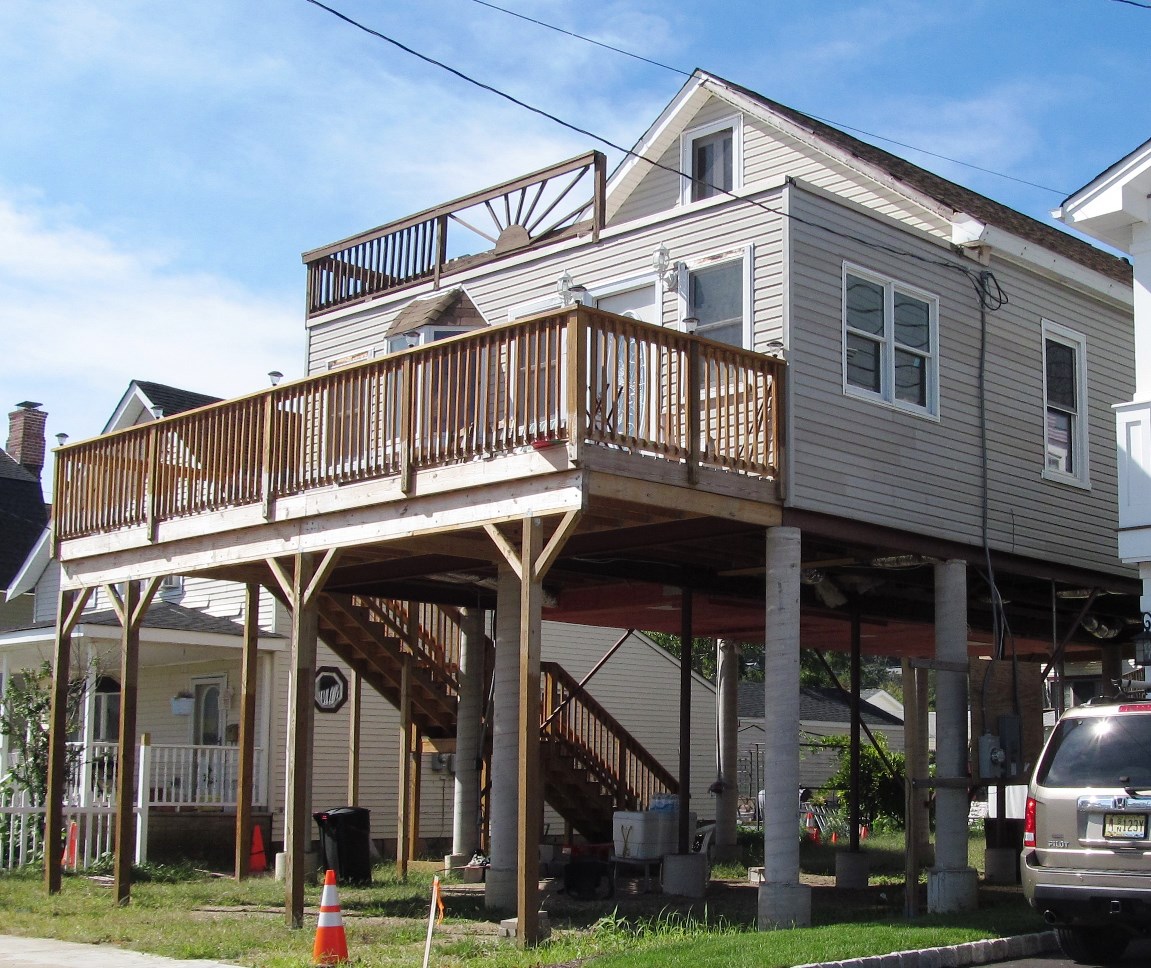
Villas must adapt to floods and storms. “After the Sandy storm”. New Jersey. (Photo: S, Å, Bjørke)
Electricity production and heating of homes have been decentralized as much as possible. The strong storms, the heavy snow and extreme ice formation periods in the short winter periods have made air cables and masts increasingly vulnerable. Cables are consequently placed in narrow corridors underground and in mountains. Much of the drilling expertise from the fossil fuel era is now engaged in drilling deep holes for geothermal heating. During warm periods, air is pumped into an underground system cooling it before it continues to central air conditioners.
Building social capital and local cohesion are important political goals, and there are plenty of open air and indoor meeting places (Watts, 2012). The previous fossil fuel era cult of worshipping and empowering ruthless profiteers irresponsibly exploiting limited natural resources or fellow human beings has been replaced with admiration for individuality, creativity, merit and compassion. Wealth is defined as overall well-being providing the freedom to become creative and unique individuals. Experiences are more important than “stuff” (Wallman. 2014). “Reckless greed for more” has been replaced with “moderation, individuality and wisdom”.
Several towns and cities with universities have specialized in attracting highly educated and creative people, “bohemians”, artists, “nerds” of various kinds, researchers and professors. They display themselves as competent, heterogeneous, multicultural and particularly creative communities. One of the catch words is the three T’s: “Technology, talent and tolerance” (Hedges, 2012). These creativity hubs attract more competent people, and creativity teams keep thinking paradigm-shifting thoughts and producing new inventions at an incredible pace.
The food prepared and served is to a large extent vegetarian.

We need animals around. They need space and clean nature. Deer, Washington DC. (Photo: S, Å, Bjørke)
Some meat comes from roaming cows, deer, sheep and goats that are kept to ensure an open, healthy agricultural landscape (Savory, 2013) . Other meat is grown on algae-substrates in big tanks run on solar energy. Vegetables are to a large extent grown privately in small-scale gardens (True activist,2012) and on terraces and roofs as well as more commercially in vertical buildings in the vicinity of the consumers (Greenwise, 2012). Farms grow ecologically, and continuously build resilience (Trites, 2013). After the great price increases on food that started taking off in 2012 (LATimes), it became clear that it is not wise to rely on huge imports of wheat, soy beans, maize and lentils for raising meat producing animals in factory-like conditions (Factory farming). The cheap and reliable delivery of foodstuff from distant countries was over with an increasingly capricious climate (Guardian, 2012)
Among the most respected and highest paid vocations is the teaching profession. Favorite subjects are natural sciences, philosophy, art, architecture, computing, robotics, nano-technology, ecological industry and creative engineering.
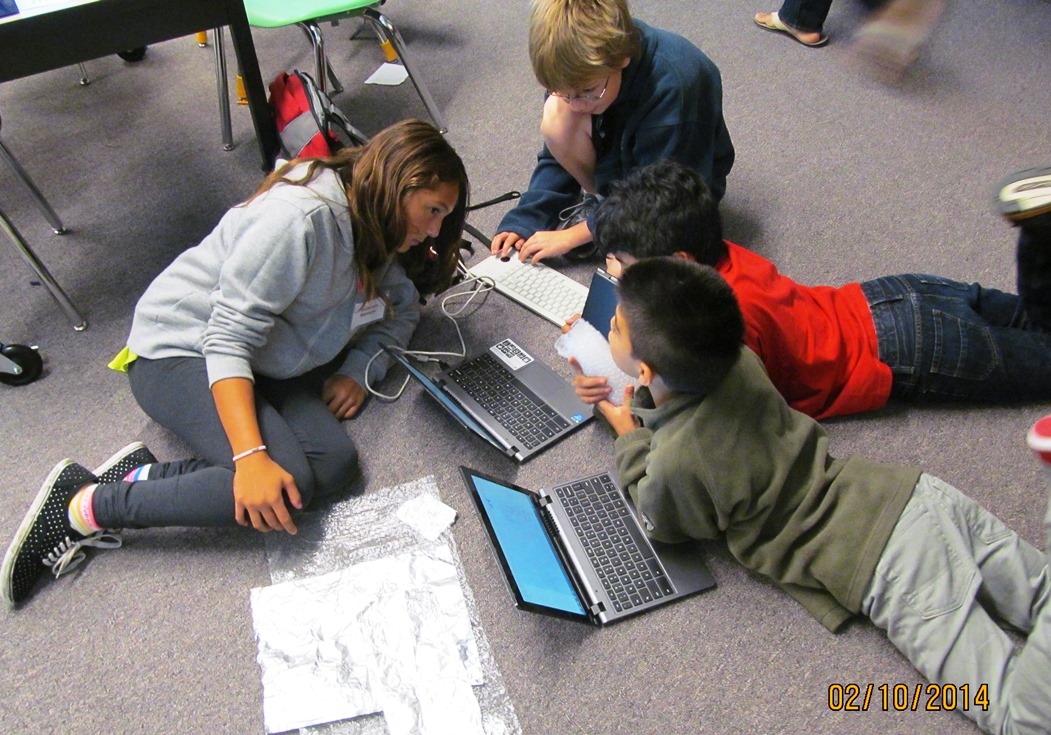
Teachers know when to vary between instructivism, constructivsm and connectivism. Transformatve pedagogy is main pedagogucal approach. Summit school, Palo Alto. (Photo: S, Å, Bjørke)
All teachers know how to balance instructivist and constructivist teaching and in what situations ICT can support learning efficiently and when it cannot. All teachers have to keep themselves constantly updated, and adult online education is a matter of course.
Industrial production and businesses all have clear corporate social responsibility profiles with triple bottom line accounting. Without such profiles it is difficult to obtain credit in the banks. Most companies define themselves as “B-corporations” where previously external costs have been internalized. A wide variety of law enforcement is available for policymakers (Ando, 2012). The legal framework within which all enterprises have to perform is strict and enforced. Multinational companies trying to pressure the legal framework in their favor by pushing external costs on the community are instructed to abide by the rules or leave the country.
The best CSR enterprises are rewarded with extra good credit rating from the banks and obtain special rates from the insurance companies (UNEP-fi, 2012). They are also enlisted on the Dow Jones Sustainability index, the only corporations that almost all pension funds are allowed to invest in. Through efficient international cooperation, the former tax havens, acrobatic financial speculation and irresponsible banking typical for the fossil fuel era were abolished 20 years ago. Tobin taxes are imposed on all international financial transactions to reduce financial speculation. Regulations are simple without loop-holes, they are concise and easily understandable and give cut-and-dried penalties.
Waste production is reduced to a minimum (Industrial ecology). All organic compounds are composted. All other elements in the value adding chain are re-used or recycled (EEA). Several industrial products can be personalized and produced in three-dimensional digital printers (3D printers). Cheap mass production of low quality belongs to an irresponsible past. Chemical use is minimized, and is subjected to strict control regimes (Jarl).

The value adding chain. The process is slowing down and waste is reduced to a minimum
There is a maximum wage set at 15 times the lowest salary, a legal minimum wage. Conspicuous consumption is regarded as primitive and hopelessly outdated. The normal fulltime working week is stipulated to 20 hours. Retirement age is of little importance, as most people are able to continue into old age working part-time and often from home offices.
This could be a description of a sustainable society of the near future.
When looking back to twenty years earlier, we can try to explain what happened.
In the period of 2012 – 2015 it became clear to most people that global warming and the challenge of climate change was becoming “so massive, so global, and so complex that it could be overcome only if we looked beyond the issue categories of the past and embrace a grand new vision for the future”. It also became clear that this issue was far too complex to leave to environmentalists to solve on their own. Environmentalists appeared too elitist and too narrow focused. Ecological thinking sees complex relationships and interactions among industrial plants, workers, health care, energy, pollution, and economic growth as no less part of the planet’s ecosystem than a forest (Nordhaus and Schellenberger, 2007, Gilding, 2013).
During the fossil fuel era, the majority of our decision makers had been used to being populists, more or less paralyzed and dictated by the interests of the big coal and oil industry.
“We stand at a fork in the road. Conventional oil and gas supplies are limited. We can move down the path of dirtier more carbon-intensive unconventional fossil-fuels, digging up the dirtiest tar sands and tar shales, hydrofracking for gas, continued mountain-top removal and mechanized destructive long-wall coal mining. Or we can choose the alternative path of clean energies and energy efficiency.
The climate science is crystal clear. We cannot go down the path of the dirty fuels without guaranteeing that the climate system passes tipping points, leaving our children and grandchildren a situation out of their control, a situation of our making” (Hansen, J. 2013).
They also tended to listen far too much to the CEOs of big and ruthless international companies rather than considering the best interests of their own people. After 2015 it became increasingly obvious that the world’s biggest corporations could not be allowed to keep on transferring political power from elected governments to their own closed boardrooms and endlessly increase their number of political lobbyists. The CEOs of Exxon Mobile, Chevron, Shell, Gazprom, Aramco, Unocal, BP. Philips Conoco, Halliburton, Koch Bros and others were never elected in democratic elections but nevertheless had more political clout than the governments of most countries (Anderson and Cavanagh, 2000).
During the financial crisis from 2008 to 2015, it became clear even to stubborn monetarists that exponential growth in a finite system (our planet) is not possible in the long run. – With a 5% annual growth, consumption would double every 14th year. There are clear limits to growth in material consumption and waste production. However, there are no limits to immaterial growth.
A sound ecology is the basis for a sound economy. – Decoupling financial economy from real economy, and letting speculation blow the financial balloons to astronomic sizes, became such an obvious folly that it had to come to an end (Theis & Tomkin). We urgently needed to wean ourselves off fossil fuels, and to pursue a sane course toward sustainable energy independence.
A new system; “green eco-economy” or “natural capitalism” was developed. The strategy was to:
- drastically increase resource productivity in order to slow resource depletion at one end of the value chain and to lower pollution at the other end;
- from year 2015 onwards ensure a 10% annual increase in energy efficiency and an annual 10% decrease in greenhouse gas emissions by a simple flat across-the board fee on the carbon content of fossil fuels, collected from fossil fuel companies at the domestic mine or port of entry, the fee gradually rising over time, the funds distributed 100 percent to the public, equal amounts to all legal residents (Hansen, 2012).
- require industrial processes to mimic biological ones in order to eliminate waste;
- base the economy on the provision of services rather than the purchase of goods;
- invest massively in regenerating natural capital and ecosystem services and pay off ecological debt;
- Build all new town- and city areas based on self-reliance, resilience, local cohesion and ecologically sound principles. Several models were started in the first decade of the century and has since developed. (See: Masdar)
- ensure income distribution and address economic and political inequality;
- abolish all “perverse” (Robin et al, 2003) and environmentally damaging subsidies and tax breaks (Nourish 9 billion.org, 2012; Koplow, 2008 ; Ochs, Anderson and Rogers, 2012)
- incorporate environmental and social costs in all prices on goods and services. Externalization of negative costs are prohibited (Ando,2012);
- reduce the materialistic, anthropocentric and contempocentric values of production and emphasize responsible, long-term values. – We borrow the world from the future. It is irresponsible and unethical to pass on reckless debts to our children (Transition network);
- invest massively in and subsidize the use of renewable, environmentally friendly energy forms and “green” technologies. This because “big, long-term investments in new technologies are made only by governments and are almost always motivated largely by concerns about national security or economic competitiveness. Governments make the long-term investments in R&D and infrastructure, and the private sector capitalizes on them to develop specific products” (Nordhaus and Schellenberger). The technology exists (UNEP, 2011);
- convincingly inform people that the era of cheap oil was over around 2006. This was based on the EROEI formula: “Energy Returned On Energy Invested”. In 1930 the EROEI in the USA was 100:1, in 1990 it was 18:1 and in 2012 it was as low as 3:1. Ninety million barrels of daily oil cannot be produced in the cheap “old” way.
- regard the market as a tool – not a master nor a religion – a tool to achieve more prosperity in general, individual self-realization, social cohesion and equity, robust and healthy ecosystems, reduce national and international tensions, reduce international organized crime and terrorism, reduce environmental risks and ecological scarcities, create sustainable jobs and lasting economic value, increase wellbeing and happiness to all, not just a few billionaires. Laissez-faire capitalism is a devastating failure in this respect: “Regulatory capture is when regulators become captives of the individuals and firms they are supposed to be watching, regulating, and disciplining when they break the law.”Industry capture” is beyond just regulatory capture. Industry capture, which is unique to only a couple of American industries (hint: oil is the other one), is when the industry itself becomes so omnipotent, so all-consuming in our lives, so all-consuming of our money, so filthy rich that it buys and sells government officials, legislators, administrations, and presidents. So powerful that it has effectively captured the nation”(Gilani, 2012); (Sutherlin, 2012); (Clark, Foster & York, 2009).
- systematically transfer political power from the big companies to democratically elected governments and ensure that politicians actually take responsibility for building democracy and sustainable development;
- reduce and eventually stop the rivers of petro dollars to corrupt, brutal and fundamentally religious dictators, sects and terrorist groups in the Middle East, Africa, Asia and in the USA (Bjorke, 2012);
- vigorously fight international and organized crime by closing tax havens and other whitewashing institutions, eliminating the use of cash and deciding that governments or presidents not democratically elected cannot legally commit their own nation to repay loans unless they can prove legitimacy. Financial institutions lending money to dictators and tyrants do that on their own risk;
- end the casino capitalism and replace it with “natural or ecological capitalism”. The neoliberalism ideology of Milton Friedman and his Chicago school is eventually perceived as what it really is; a criminal ideology systematically stealing wealth of all kinds from the big majority while creating a handful of corrupt multibillionaires and plutocrats. The neoliberal ideology has depleted and polluted ecosystems and natural resources, built enormous ecological debts, channelled fortunes to corrupt psychopaths, tyrants, traffickers, weapon smugglers and warmongers, tobacco kings, mobsters and carbon barons. It has provided tsunamis of petrodollars to the most tyrannical and bloodthirsty regimes in the world. The ideology removed all restraints on unethical and ruthless casino capitalist institutions like e.g. Enron and Lehman Bros. and Goldman Sachs. They deliberately make new financial crises every 6-8 years. Ordinary people have to pay, the billionaires get richer. These strange institutions that privatize all profits when they win, and come running (or flying in their private jets) to the governments for taxpayers money when they lose. The monetarist ideology is simple and brutal: internalize profits, externalize costs! Make the public pay! It is time to put the corrupt CEOs in prison and replace them with ethical, social and environmentally responsible bankers. Examples: Triodos Bank Foundation and Global Alliance for Banking Values. “The old economy of greed and dominion is dying. A new economy of life and partnership is struggling to be born” (Korten, 2012)
- mobilize the broad masses of the public by inviting, churches, mosques and temples. “Mainline Protestants and liberal Catholics, Jews and Quakers, Unitarian Universalists and the rising wave of reformist Muslims — are the strongest remaining cultural forces left with the moral authority to insist that we have a duty to the poor, that democracy cannot survive without a commitment to justice, and that compassion is always a better survival strategy than competition (WCC,2012). The market says: Everything and everybody has a price, and is for sale. Faith says: The most valuable things in our lives — good health, safe food, strong families, a clean environment, a just economy, meaningful work, access to opportunity — are beyond price, and should by right be available to us all” (Robinson, 2012).
- mobilize NGOs, Rotary, Lions, Inner Wheel, Kiwanis, Boy and Girl Scouts and similar organization, private sector, schools etc must be encouraged to participate in mass movements for transforming the world from the fossil fuel paradigm to the sustainable society paradigm. Democracy does work better than corpocracy.
- declare an end to disharmony, and commit to an age of peace, co-creativity and global coherence (Hubbard, 2012)
- be a clear alternative: be in favor of the secure, moderate, prosperous, responsible and sustainable society, and demand the “carbon barons” and their “carbon agents” to explain what points above they are against and how their future society will look like.
In hindsight it seems the year 2012 was a turning point. The signs of climate change were increasingly evident. Floods, droughts, massive forest fires, unusual weather, more extreme storms all over the world made it clear that the former economic system increased the general, uneasy feeling of insecurity, caused tension and conflicts and depleted ecosystems. Governments could no longer guarantee the future ecological and economic security for its people within the framework of the system. Reduced food production combined with reckless speculation led to dramatically increased food prices. Extreme-Christians as well as extreme Islamist fundamentalist groups ran a depressing and aggressive doomsday discourse. Many disillusioned environmentalists also expressed that major eco-disasters and the end of civilization seemed inevitable. Strikingly enough, the ancient Mayan civilization calendar stopped in December 2012. It was around that time that the transformative changes leading to the economic and ecological paradigm shift took off.
Literature:
Anderson, S. and Cavanagh, J. (2000) Top 200: the rise of corporate global power
Marshall, A.G. (2012) No Conspiracy Theory — A Small Group of Companies Have Enormous Power Over the World
Ando, A. (2012) Tragedy of the commons – externalities, Theis & Tomkins, Sustainability: A Comprehensive Foundation
Ando, A. (2012) Solutions: Property Rights, Regulations, and Incentive Policies, Theis & Tomkins, Sustainability: A Comprehensive Foundation
Cities of the future and ecosystems
BBC News (2013) The city of 2050 | What if you could design a city? | How will your future cities look like? | How Design is Making the World More Sustainable | Eight Reasons for Optimism on Climate Change (Feb 2014) | Humanity’s Crisis Is Systemic and Overwhelming—And the Only Way Out Is to Create Bold New Systems (March 2014) | | Loveable Places Are Sustainable (March 2014) | Habitats for humanity: Why our cities need to be ecosystems, too (March 2014) | Green urban infrastructure could save $17trn by 2050 |
B-corporations (2012)
Bjørke, S.Å. (2012) Green eco economy
Bjørke, S.Å. (2012) Climate change
Clark, B., Foster, J.B. & York, R (2009) Capitalism in Wonderland, Monthly Review,
CSR-Norge (2012) Corporate Social Responsibility | Emerging Green Technologies for the Manufacturing Sector |
Danson, Casey (2012) Steam without boiling water: nanotechnology using sunlight for power
Green infrastructure
Danson, C. (2013) A road can be more than a road | Green infrastructure becoming mainstream | Electric roads could make plugging in your EV a thing of the past | The hyperloop transportation system | Streetcars Save Cities – Slideshow | This Is What Los Angeles Could Look Like In 2033 | They paved paradise and put in … some solar panels? | Why light electric vehicles will outpace cars before you know it (May 2015) | What is the mobility of the future |
Dow Jones Sustainability Index (2012)
EC (2012) Green infrastructure|
The C40 Cities Climate Leadership Group |
Eckblad, G. (1986) Det andre landet, Solum forlag, Oslo
Eco global society (2013) Mitsubishi driverless skytrain
EEA (2012) Climate change adaptation in Europe
Unsustainable consumption
EEA (2012) Unsustainable consumption – the mother of all environmental issues?
| Monbiot (2012) Face it: our level of consumption is pathological | A global movement for climate justice | We can work less, make more money and save the planet | Debunking inequality myths | Genuine progress indicators (GPI) | How Economic Inequality Kills: The appalling human costs of our current economic system (March 2014) |
Factory farming
Factory farming | Cook organic – not the planet | Halve meat consumption scientists urge | Plant matters: Is photosynthesis the best defense against climate change? | Unbelievable Ways Companies Are Trying to Keep You From Seeing Where Your Meat Comes From | Monsanto’s GMO Feed Creates Horrific Physical Ailments in Animals | Gatesnotes: the future of food | How to feed the world | 6 Crimes Against Nature | Perpetrated By the Food Industry | World’s Largest Indoor Farm is 100 Times More Productive |
Gilani, S. (2012) Wall Street Has Set You Up Like a Bowling Pin , Money Morning, http://moneymorning.com/2012/08/17/wall-street-has-set-you-up-like-a-bowling-pin/ | Danson: How I Learned to Cheat on Wall Street |
Gilding, P. (2013) Victory at hand for the climate movement, Post carbon inst.
Vertical farming
Greenwise (2012) Taking horticulture to new levels: vertical farming, | Vertical sea farming | Pop-up cold-climate greenhouse could help revitalize urban spaces | World’s First Vertical Forest Gets Introduced in Italy | MIT city farms | Vertical harvest urban farm by e/ye design under construction |
Guardian (2012) The era of cheap food may be over | Climate change and food supply (NY Times sept 2012) | World Bank warns against complacency amid high food prices and hunger (Dec 2012) | Our coming food crisis (NYT, July 2013)
Hansen, C. (2014) Greening your roofs |
Hansen, J. (2012) Storms of my grandchildren’s Opa
Hansen, J. (2013) A Fork in the Road
Hedges, C. (2012) We Need Free Thinkers Or Society Will Shrivel Up and Die
Hubbard, B.H. (2012) Birth 2012 and beyond, shift books
Jarl, S. () Underkastelsen
Eco-economy
Koplow, D. (2008) Subsidies and market interventions, Encyclopedia of the Earth,
Korten, D. (2012) Living Economies Forum | Pledging for change | BALLE | American towns leapfrogging towards a greener future | The economy under new ownership -how cooperatives lead the way | There is an alternative to capitalism | Mondragon | 8 Ways the Prophets of Capitalist Greed Justify Their Success and Your Slide Toward Poverty | How Greedy Financial Titans Crushed Innovation and Destroyed Our Economy | After we stop the Machine, how do we create a new world? | Joe Stiglitz: The People Who Break the Rules Have Raked in Huge Profits and Wealth and It’s Sickening Our Politics | Vasakronan issues the world’s first green corporate bond |
Good-bye Milton Friedman, Hello Joseph Stiglitz! Progressive Economists Can Help Save Working America | Sustainable living | Major Social Transformation Is a Lot Closer Than You May Realize — How Do We Finish the Job? | Barber, B. (2009) Climate Change and the Politics of Interdependence | Common Good Finance: real democracy, real money, real power | Rcredits – community created credits | | Green Technology Is Paying Off for GE || Sustainable business || Ecological footprints -treading lightly on the planet ||
Los Angeles Times Business (2012) World Food Prices rose by 10% in July | Climate threat to world’s poor underestimated (Oxfam report sept 2012) | | How severe weather impacts on food prices (Reuter, Dec 2012)
Masdar and other renewable energy city experiments
Masdar Experiment sustainable town || American towns leapfrogging towards a greener future || Space age rapid transit to debut in Tel Aviv || How a Country With One of the World’s Largest Economies Is Ditching Fossil Fuels || Renewable energy is becoming cheaper than fossil fuels || Solution to Climate Woes: Triple-pane Windows~!!! || The next big thing in energy: decentralisation || US solar energy broke records || There is an alternative to capitalism || Mondragon || Clean technica: clean power || Abundant clean energy for & by the people || German bank reports solar power cost in India and Italy has reached grid parity || Sustainable Prosperity Requires Balance || Hairy, el-producing skyscraper || Is Concentrating Solar Power The Technology That Saves Humanity? || CAP Economic Report ’300 Engines Of Growth’ Features Clean Energy And Climate Solutions || Better, more reliable wind turbines || Solar energy: how close is an off the grid reality? || A High-Renewables Tomorrow, Today: Greensburg, Kansas || 10 Best Cities for the Cleanest Air in the World || 100% sun, wind, and water can power each U.S. state and the world –Stanford study || Moors, K. (2014) Has Solar Power Finally Arrived? ||
McKibben, B. (2012) Global warming’s terrifying new math, Rolling Stone July 2012
MiT(2013) Ionic wind thrusters
Urban challenges
Munich re (2012) Turning the urban challenge into an opportunity |
Cities in the age of climateconsequences (Grist) | The value of ecosystem resilience to insurers | Climate wise: reducing the risk for tomorrow | The Brooklyn Grange
Nordhaus, T. and Schellenberger, M. (2007) Break through. Why we can’t leave saving the planet to environmentalists, Mariner
WEN (2012) California planning low-carbon oasis
Nourish 9 billion.org (2012) Perverse subsidies |
Ochs, Anderson and Rogers (2012) Fossil Fuel and Renewable Energy Subsidies on the Rise, Vital Signs, Worldwatch institute, | Energy subsidy reform IMF 2013
Philips (2014) The Red Hot Renewable That Could Incite A Green Power Revolution – geothermal energy ||
Robin, Wolcott & Quintela (2003) Perverse subsidies and the implication for biodiversity
Progressive religion
Robinson, S. (2012) Six Reasons We Can’t Change The Future Without Progressive Religion, Alternet, 8 July 2012 | Desmond Tutu meets Richard Branson | Slaves to Our Stuff: A Creative Vision to Break Away From Consumer Culture’s Destructive Grip | Pope Francis Attacks ‘Idolatry of Money,’ Says Inequality ‘Kills’ | Pope Francis: We Are ‘Stewards, Not Masters’ of the Earth |
How a MIT Science Prof Is Threatening to Undo Everything the Religious Right Holds Dear
Savory, A. (2013) How to green the desert and reverse climate change
Energy storage and batteries
Sadoway, D. (2012) The missing link to renewable energy | Tesla power: Wireless electricity is here | Critical look | Prieto battery || Grafen batteries loads in Seconds || Fremtidens batteri || Grafen – – framtidens superstoff ||
Scotland, M. and Henderson, C. (2012) Solving the energy storage conundrum, Green futures magazine, | Aquion energy and AHI battery technology | Solving the biggest problem of renewables? | See The Scientific Accident That May Change The World (Or At Least Your Battery Life) | How we can prevent catastrophic climate change with a clean energy revolution. | Flash Charging is here – Electric Buses… what’s Next? | Graphene breakthrough could unlock renewable energy’s potential | | The Future Of Renewable Energy Can Now Be Found Inside A Shipping Container Sitting Off The I-95 Corrido | Renewable energy for all (UN & World Bank, 2013) | Flow battery breakthrough scales cheaply to store renewable energy without scarce metals | The “Holy Grail” of Energy Investing Is Going to Make You – and Your Grandchildren – Rich |
Sutherlin, L (2012) A worldwide corporate powergrab of enormous proportions | The Shocking Amount of Wealth and Power Held by 0.001% of the World Population | Multinational Greed Is Threatening the Stability of Societies Across the Planet
Theis, T. and Tomkin, J. (2012) The vulnerability of industrialised resources systems, in Theis & Tomkins, Sustainability: A Comprehensive Foundation, |
Transition network
Green banking
Triodos Bank Foundation | Institute for social banking | All about green banking | Global alliance for banking on values | The Sekem project for sustainable human development | The Schwab foundation for sustainable social entrepreneurship | 10 Steps to Break Up the Wealth of the Super Rich | American sustainable business council | Sustainable business blog | Sustainable happiness | UNEP: Online Guide to Banking & Sustainability | Principles for sustainable insurance | Principles for responsible investements |
Green agriculture
Trites, K. (2013) Farmer-Philosopher Fred Kirschenmann on Food and the Warming Future | Agriculture of the middle | Resilience alliance | For farmers everywhere, small is still beautiful | What India taught me about how to end hunger | Women farmers feed the world | Farmers, workers, consumers unite! New vision for food justice | The video Coca cola and McDonalds hope you’ll never see
True activist (2012) Russia’s small-scale organic agriculture model may hold the key to feeding the world
Technological transformation
UNEP (2011) The great green technological transformation (UN), | Nuclear and renewable energy facts | Solar Panels with World-Record Efficiencies of 21.5 Percent | Could This Zero-Emissions, Triple-Decker Solar Plane Revolutionize the Aviation Industry? | Why One Little Plane Will Change Flight Energy Technology Forever (Money morning Aug 2015) 1 Landmark hybrid electric aeroplane wins new funding March 2016 |
UNEP fi (2012) Innovative financing for sustainability
From materialism to experientalism
Wallman, J. (2014) Stuffocation, : We’re suffocating in stuff. Buy less, do more: 5 reasons why experiences make us happier than things. We need to shift away from a culture of materialism and toward one of experientialism (March 2014)
Watts, B. (2012) There’s more to sustainable societies than a room of your own, Greenfutures magazine | Sustainability is unhelpful: we need to think about regeneration (Guardian, 2013)
Religion for sustainability
WCC World Council of Churches – care for creation and climate
Green acrhitecture
World Green Building Council | World green roofs | Green rooftops blog | Why we should use our roofs in the fight against climate change? | Architecture for humanity | Mother nature network | Leadership in Energy and Environmental Design (LEED) | Amazing new house proves that green doesn’t have to mean expensive | Passive House movement gets noticed by the New York Times | Norwegian green building council | Build resilient in an unstoppable world | Underinvesting in resilience – Get resilient | Zero-energy building | The impact of green space on urban communities | New solar structures cool buildings in full sunlight | Building a climate resilient nation | The importance of green roof infrastructure | Titan Brick – for green construction | Finland’s floating village | With help from nature, a town aims to be solar capital | Lessons for building a solar economy | Green roofs | Island in the sun: Why are our cities heating up faster than everywhere else? | L.A. launches nation’s largest solar rooftop program | Sustainable Architecture: 5 Reasons To Love Green Buildings | Neighborhood units matter | The case for place-making without the sprawl | Green Inventions: 10 Hot Eco-Innovations That Could Change The Planet (PHOTOS) | How better urban design makes us healthier, happier and sexier | Cities can be symbiotic, not parasitic? | Symbiotic cities’ network | A new take on suburbia | Designing urban agriculture | The Active House comes to Canada with a restrained modern design by Superkül | Three Perspectives on Designing Resilient Cities | Architecture in Tune With the Climate | How self-driving cars might change our cities | 11 great reasons why Passive House is such a great green building standard | Concept house in Nova Scotia pushes every green button | Zero energy homes have arrived | Heliotrope: The World’s First Energy Positive Solar Home | | Dome Homes Could Save Everyone From Hurricanes, Earthquakes And Flying Cars | Discover Green Building with GBIG | Going Green in 2014: A Conversation with Two Thought Leaders on Urban Green Design | A Passive House is built on stilts | They are calling this year’s New American Home “the greenest in history.” (Feb 2014) | Harvest Home in Colorado: what we mean by green and sustainable (Feb 2014) | Sustainable green building methods (March 2014) | Greening Our Cities: It Takes a Village. Building green infrastructure (March 2014) || Why would you build a round house (March 2014) | | How Do We Make Our Cities More Resilient? Make Them More Natural (April 2014) | | How one building is changing the world (Oct 2014) | Futuristic Paris Smart City is filled with flourishing green skyscrapers…(Jan 2015) | MenoMenoPiu Architects design tiny capsule hotels with stunning views of the Parisian waterfront | | These bizarre, beautiful cities of the future are also super green | I never realized how dumb our cities are until I saw what a smart one looks like. || Constructing the City of the Future (Saudi Arabia) || House of the Future Is Here Today, Generates Twice the Energy It Uses || The Future of the Battery Powered Homes || The world’s largest green roof in Silicon Valley || Green roofs – vision for the future || The 21st century needs its own paradigm shift in architecture || This vertical village looks like a jungle towering 36 stories into the sky (March 2016) ||

 Education for Sustainable Development
Good rreading
LikeLike
fantastic points altogether, you simply received a new reader.
What might you suggest in regards to your put up that you made some days
in the past? Any certain?
LikeLike
Wow, awesome blog layout! How long have you been blogging for?
you make blogging glance easy. The full glance
of your web site is magnificent, as smartly as the content!
LikeLike
Hello! Would you mind if I share your blog with my twitter group?
There’s a lot of people that I think would really appreciate your
content. Please let me know. Thanks
LikeLike
Please do – share it with as many as possible and ask others to share it, copy it, use it – that’s the intention.
LikeLike
Great post. I was checking continuously this blog
and I am inspired! Very helpful info specially the last phase
🙂 I care for such info much. I used to be seeking
this particular info for a very lengthy time. Thank you and best of luck.
LikeLike
Great goods from you, man. I’ve bear in mind your stuff previous to and you’re just too excellent.
I really like what you have got here, certainly like what
you are saying and the best way through which you assert it.
You make it entertaining and you still take care of to stay it wise.
I can not wait to read much more from you. This is really a great web
site.
LikeLike
Pingback: Make 2014 the climate year! | Education for Sustainable Development
This is a great article Ake, I wish you could give a link to ‘industrial ecology’ or a bit more information about it.
LikeLike
Hi Doreen
I have added some links on Industrial technology under the artcile called Green eco economy, under “Technology”. Maybe those links could be useful as a starting point? https://ufbutv.com/sub1/
LikeLike
Pingback: Building the Future: Hotels Change Policies for Eco-Travel Initiatives | Education for Sustainable Development
Pingback: Oljealderen må avvikles nå | Education for Sustainable Development
Pingback: Out of fossil fuels now! | Education for Sustainable Development
Pingback: Two or three degrees more – does it really matter? | Education for Sustainable Development
Pingback: Cocksure statements on climate change? | Education for Sustainable Development