
by
Sven Åke Bjørke

Fire infernos, warmer and rising seas, intense heatwaves followed by global refugee crises, extreme weather, dry rivers and reservoirs, glacier lake outburst floodings, galloping insurance premiums, damaged agriculture, air pollution, threatening ecological tipping points and societal disruption. A super-El Niño can take us further into the unknown. These are likely consequences of our inability to curb greenhouse gas emissions. Climate change is underway, and it will get worse. Yet politicians seem paralyzed. Most of us are. Is part of the explanation that powerful economic interests benefit from paralysis? Are we being manipulated into doubting – or simply giving up? Here are some facts about fossil energy and human-caused global warming.
100 million barrels of oil every day
The world consumes around 100 million barrels of oil every single day. One barrel contains 159 liters, almost a full bathtub. In total, this corresponds to about 16 billion liters of oil – every day. When a liter of diesel burns – or oxidizes, as the chemical process is called – it does not disappear. The carbon in the diesel binds with oxygen from the air and is transformed into CO2. Burning one liter of diesel produces, among other things, about 2.66 kg of CO2. There are also emissions associated with extracting, processing and transporting crude oil. Burning 159 liters of petroleum products ultimately adds 420 kilograms of CO2 to our common atmosphere.
We burn enormous quantities of coal and gas as well. Taken together, global consumption of coal, oil and gas represents a continuous flow of fossil carbon into the atmosphere – day and night, year-round of about 30 billion litres of oil equivalent, or 300.000 litres per second 24/7.
It would be extraordinarily naïve to believe that this has no consequences.
Oil, coal and gas are fossil fuels in which nature has stored carbon for millions of years. Over the course of just two centuries, we have extracted a large part of this carbon from the ground and released it back into the atmosphere and oceans. Fossil carbon is not part of the rapid, daily or annual carbon cycle in which living organisms respire and plants absorb CO2 through photosynthesis. Burning fossil fuels adds extra carbon to the natural carbon cycle.
USD 50-120 per barrel – gold for billionaires
The market price of a barrel of oil can fluctuate dramatically and has at times approached USD 120. Crude oil is traded globally in barrels, normally priced in US dollars.
If we take daily consumption of roughly 100 million barrels and multiply it by a conservative USD 60, we get some idea of the scale of the global crude-oil market: about USD 6 billion a day. And that is only crude oil. On top of this comes activity throughout the value chain: tanker transport, refineries and the retail sale of petroleum products such as gasoline, diesel, kerosene, asphalt and plastics. Coal and gas add further enormous markets. The international fossil-fuel industry is therefore exceptionally resourceful and politically influential. Around the world, fossil fuels also benefit from substantial subsidies and other forms of public support.
Behind many of the world’s largest oil and gas companies are either petroleum-exporting states or some of the world’s most capital-rich investor communities. Saudi Aramco is the world’s largest oil company and one of the world’s most valuable companies. Collectively, the largest international oil and gas companies command resources and capital that give them economic and political influence few other industries can match. The United States, Saudi Arabia and Russia are the world’s dominant oil producers, and fossil-energy interests remain deeply intertwined with geopolitics. Without oil revenues, Russian and Arabic economies will collapse, and the US economy would face severe problems.
$3,000 a second in profit – six of around 700 oil companies
Six of the world’s largest fossil-fuel companies are expected to make close to $3,000 in profit every second in 2026, according to an analysis by Oxfam International – at a time when many households are struggling with high energy prices and the cost of living.
According to the Oxfam analysis, Chevron, Shell, BP, ConocoPhillips, ExxonMobil and TotalEnergies are projected to make about $2,967 a second in profit in 2026. The estimate illustrates the extraordinary financial scale of the fossil-fuel industry.
Considering that there are more than 700 oil companies in the world, among these the much larger like Aramco, Sinopec, Petrobas, Rosneft, Petrobras etc. , it should be fairly safe to guesstimate the world’s total oil profits to be more than 20 times higher. With the ongoing wars in the Middle East, a doubling is likely during the coming year.
Billions of petrodollars for disinformation, denial and propaganda
The financial interests in prolonging the fossil-fuel era are enormous. Over many decades, parts of the fossil-fuel industry and organizations aligned with it have funded campaigns that cast doubt on climate science and oppose climate policy. Right-wing American think tanks such as the Heartland Institute and the Heritage Foundation have been prominent in this debate. Russian influence operations have also helped spread climate disinformation and amplify polarizing narratives about climate and energy policy. The result is an information environment in which well-established science is repeatedly presented as if it were still fundamentally uncertain.
More than 35 billion tonnes of CO2 per year
Burning fossil fuels releases more than 35 billion tonnes of CO2 into the atmosphere every year. This carbon dioxide does not simply disappear. Some is absorbed by vegetation and the oceans; a substantial share remains in the atmosphere, and its effects persist for centuries.
A dramatic increase in just 200 years
For most of the Holocene – the geological period covering roughly the last 12,000 years – atmospheric CO2 remained within a relatively narrow range. Ice cores show that, for hundreds of thousands of years before the industrial era, atmospheric CO2 did not exceed about 300 ppm. The well-known Vostok ice-core record from Antarctica reaches back more than 400,000 years. It was during the unusually stable climate of the Holocene that agriculture developed and permanent human settlements expanded. The transition from nomadic life in the Paleolithic to more settled societies in the Neolithic was one of the great transformations in human history. Today’s rapid climate change therefore has profound implications for agriculture and food production. Human civilization has developed within a remarkably stable climatic corridor.
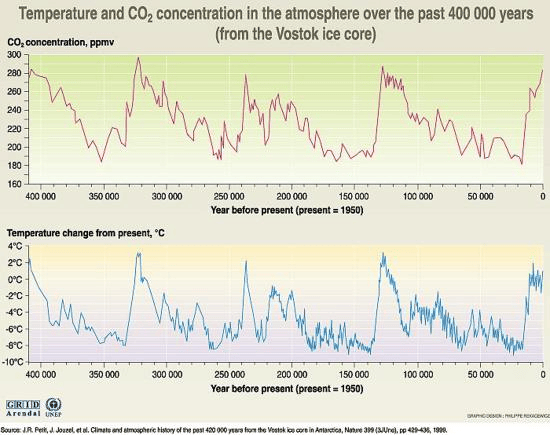
Usually, changes in incoming solar radiation are the initiating forcing factor e of climate change. CO2 is usually a “feedback” mechanism that amplifies the original radiative forcing and follows temperature fluctuations. Such Milankovich cycles run over thousands of years and are completely natural. The blue curve shows the relative stable climate of the last 12000 years. Significant global warming over a 100-year period is not natural.
No natural variation
In the heated climate debate, the warm period several thousand years ago – often called the Holocene Thermal Maximum – is sometimes cited as evidence that today’s warming is merely natural variation. But the comparison is misleading. That earlier pattern was driven primarily by slow changes in Earth’s orbit and the distribution of incoming solar energy. It was not a globally uniform warming comparable to what we observe today. The causes, geographical patterns and speed of change were fundamentally different.
What is happening now cannot be explained by natural climate variation alone. Changes in solar radiation, Earth’s orbit, volcanic activity and other natural factors are well known to climate science, but they do not explain the rapid, strong warming observed since industrialization. The evidence shows that human activity – above all the burning of fossil fuels – is the dominant cause of the current global warming. We can already observe the consequences as the Earth’s climate, and with it ecosystems around the world, change rapidly.
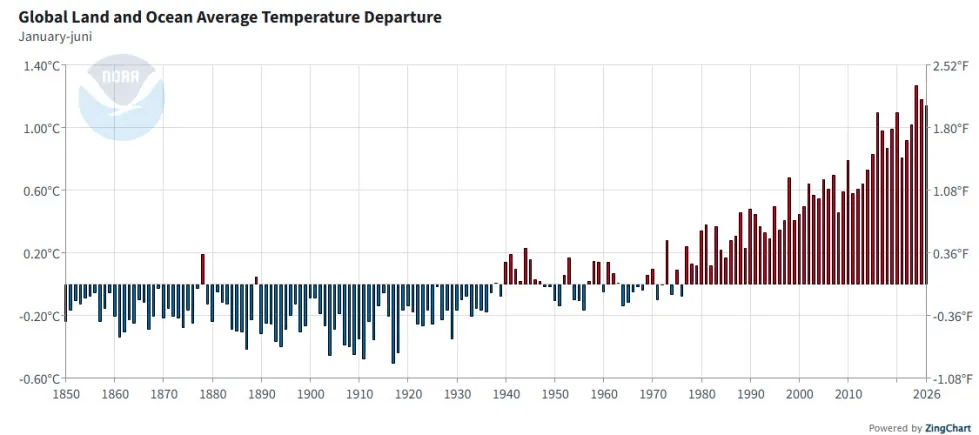
Atmospheric CO2 has risen rapidly since the Industrial Revolution, from about 280 ppm to well above 400 ppm today. Global temperatures have risen sharply as greenhouse-gas concentrations have increased. We are conducting an unprecedented experiment with the only planet we have. And we are the guinea pigs.
An overwhelming scientific consensus
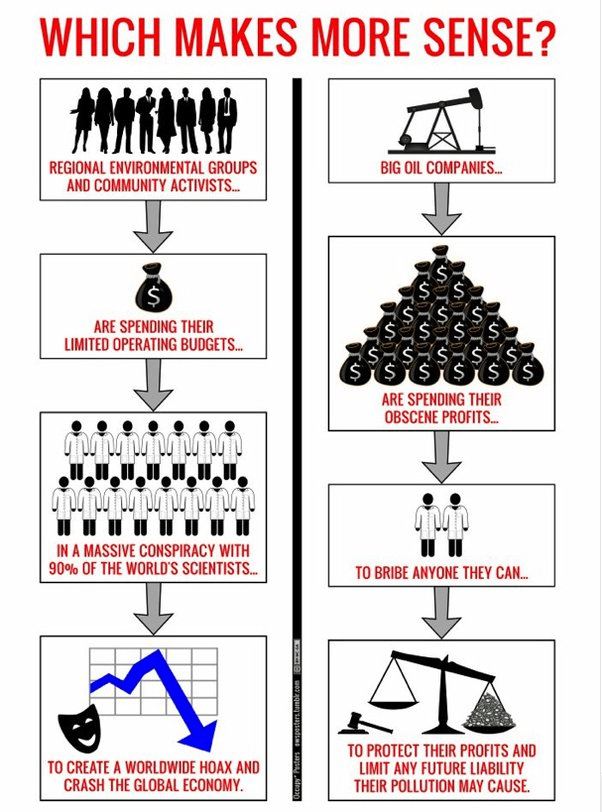
Among actively publishing climate scientists, the consensus that humans are causing current global warming is overwhelming. The precise percentage depends on how studies define expertise and consensus, but the conclusion does not: there is no serious scientific dispute about whether human activities are warming the climate. The important scientific questions concern how fast particular changes will unfold, how severe their impacts will be and how societies should respond.
The 2015 Paris Agreement seeks to hold the increase in global average temperature to well below 2°C above pre-industrial levels and to pursue efforts to limit it to 1.5°C. Every additional fraction of a degree increases risks. Treating these thresholds casually is a form of Russian roulette – except that the consequences will be borne not only by us, but by our children and grandchildren.
It is no consolation that the Earth has been warmer in the distant geological past. Millions of years ago, temperatures and sea levels were very different, as were ecosystems and the distribution of life. Nor do individual hot years or cold years tell us much about the long-term trend. What matters is the global pattern over decades. The warmest years in the instrumental record are overwhelmingly concentrated in the recent past, and extreme heat that was once exceptional is becoming much more common. Attribution science can now quantify how human-caused climate change makes many heatwaves and other extremes more likely and more intense.
The summer of 2024 was the hottest ever recorded until 2025 smashed that record, and now 2026 is set to possibly top that too. This is why scientists have found that this recent heatwave was impossible without man-made climate change
The Earth is warming. Extremes are becoming more common.
A warmer atmosphere can hold more water vapor
Warmer oceans and air increase the amount of water vapor the atmosphere can hold. Water vapor is itself a powerful greenhouse gas and acts as an important feedback mechanism: initial warming caused by CO2 and other greenhouse gases allows more water vapor to accumulate, amplifying the warming. A warmer atmosphere can also contribute to heavier precipitation and flooding. Climate change can alter large-scale atmospheric circulation and increase the risk of persistent weather patterns and atmospheric rivers in some regions. Natural greenhouse gases make the Earth habitable; additional human-made greenhouse gases disturb that balance and give the planet a “fever”. Even a seemingly small increase in global average temperature can trigger large natural feedbacks and push ecosystems toward critical tipping points. Ecologists and climate scientists have warned about these risks for decades. Yet effective action remains painfully slow. The dance around the golden calf of oil is still too tempting.
From fossil fuels to decentralized renewable energy
Fossil energy is ultimately a sunset industry. Renewable electricity is expanding rapidly, technologies are improving and the economics of energy are changing. The transition will not happen overnight, and fossil fuels still supply a large share of global energy. But the direction of travel is increasingly clear.
Over the next 10–15 years, we should accelerate the transition toward non-fossil energy and, where practical, produce more energy locally. Decentralized systems can strengthen resilience and reduce exposure to volatile international fuel markets. Electrification is also inherently more efficient in many applications: combustion engines and fossil-fuel systems lose large amounts of energy as waste heat, while electric technologies can deliver the same useful service with far less primary energy and much lower emissions when powered by clean electricity.
More decentralized energy production and local ownership can improve preparedness, resilience and the distribution of economic benefits. Part of the income from exporting electricity could, for example, be returned to citizens as an “Electricity Bonus”, rewarding energy saving and investment in renewable energy. The transition to a fossil-free society is demanding and requires major investment. But failing to make the transition will also carry enormous costs: higher insurance losses, floods and droughts, more unpredictable weather, loss of nature, pollution, migration pressures, higher food costs, ocean acidification, landslides, conflict risks and damage to infrastructure.
Renewable energy can provide greater predictability, preparedness and resilience. A less fossil-dependent society can also be less vulnerable to geopolitical shocks.
Renewable energy sources such as solar, wind, hydro, tidal and geothermal power can dramatically reduce greenhouse-gas emissions and air pollution. Their underlying energy resources are widely distributed across the globe, making greater energy self-sufficiency possible in many countries. Local renewable energy is less dependent on decisions made in Washington, Moscow or Riyadh, or on shipping through the Strait of Hormuz. The technologies for renewable power, electrification and batteries already exist, although they must continue to improve and scale much faster. The transition is well underway. We can choose to invest, innovate and participate in it – or allow other countries, not least China, to dominate the technologies and industries of the emerging energy system. That is a political choice – for the time being.
Sources and further reading
Oil
- Oil market report
- EIA International energy statistics
- The world’s biggest oil producers
- The world’s biggest oil exporters
- The World’s 10 Biggest Oil Exporters
- List of largest oil and gas companies by revenue
- Carbon majors
- The World’s Largest Oil And Gas Companies 2017: Exxon Reigns Supreme, While Chevron Slips
- Crude Oil Exports by Country https://www.worldstopexports.com/worlds-top-oil-exports-country/
- The carbon cycle (NASA)
- IMF Experts and Others Envision a World without Energy Subsidies. IMF calculates real subsidies to fossil fuels to be USD 2 trillion annually
- U.S. Spending Bill to Grant $40 Billion in Fossil Fuel Subsidies
- IMF: Fossil Fuel Subsidies
- Global Oil Demand Falls for the First Time Since COVID
- The 10 Largest Coal Mines in the World
- Giant fossil fuel companies made about $12,000 in the time it took you to read this headline
- Revealed: major oil firms make $93bn profits amid war and climate crisis
- Oljenæringen slipper unna mesteparten av klimaregningen – kan betale enda mindre snart
- Tech vs. Climate – DeSmog
- Carbon Majors Entities
- War! What is it good for? Absolutely humongous oil company profits
Greenhouse gases
- NOAA – Mauna Loa
- Keeling curve
- Explaining climate science
- NASA climate
- Union of concerned scientists: Global warming
- UN/IPCC: AR6 Synthesis Report
- The greenhouse effect and greenhouse gases
- The sun?
Impacts
- Climate crisis-driven heat ‘sucking soils dry’ as extreme drought hits Europe
- ‘Extremely scary findings’ show climate crisis is supercharging Europe’s wildfire weather
- Destroyed crops, riverbed cyclists and a ‘Rock of Starvation’: how drought has devastated the Danube
- Europe is burning – and if Trump’s war on the climate is not met with sanctions, things will only get worse
- Antarctic winter sea ice falls to third-lowest level on record as scientists warn of ‘now problem’
- Re-insurance – sounding the alarm!
- Climate.us
- Europe’s rivers are running dry, and the knock-on effects are disastrous
- European farmers face ‘unprecedented crisis’ after successive heatwaves
- What is a ‘fire cloud’, and how have they worsened wildfires in Europe?
- World’s oceans losing their greenness through global heating, study finds
- Nepal’s glacial collapse foreshadowed a future of climate disaster
- What we know about the link between Nepal’s flash floods and our climate crisis
- The US west has lost nearly 300 glaciers since the 1960s. Climate crisis is drastically shrinking what’s left
- ‘We have lost everything’: extreme rainfall across Asia brings flash floods and typhoons
- How much is sea level rising?
- A California town’s beaches are washing away. Can its residents turn the tide?
- Extreme heat
- Why A Record-Hot Ocean Is Supercharging The El Niño Effect
- ‘Our new normal’: how marine heatwaves affect life in British seas
- ‘It’s only going to get worse’: wildfires forcing firefighters to make impossible choices
- July 25, 2026 — Europe wildfires force over 250,000 evacuations in France and Spain
- ‘I just want to find them’: deadly cloudbursts devastate Kashmir’s mountain communities
- Temperature and CO2 concentration in the atmosphere over the past 400 000 years | GRID-Arendal
- NCDC/NOAA: Global climate change indicators http://www.ncdc.noaa.gov/indicators/
- NASA: Climate change: How do we know? http://climate.nasa.gov/evidence/
- NASA: GISS Surface Temperature Analysis http://data.giss.nasa.gov/gistemp/graphs /
- Weather tracker: Heatwave breaks June temperature records across Europe | Extreme heat |
- Summer 2024 was world’s hottest on record – BBC Weather
- Costs of extreme weather https://www.nature.com/articles/s41467-023-41888-1
- Fossil fuel emissions have rapidly worsened European heatwaves in just a few decades – World Weather Attribution
- Impacts of global warming
- Quantifying climate loss and damage consistent with a social cost of carbon (Nature)
- Trump’s attempt to crush clean energy progress not going to plan, experts say US generated more power from renewables including solar and wind than gas last month
- Risks | Munich Re
Extreme weather
- France records hottest day ever as 40 people drown across country
- Thousands flee wildfires in France and Spain as temperatures reach extreme levels in southern Europe
- Searing UK heat leaves schools, hospitals and transport networks struggling to cope
- ‘Supersizing before our eyes’: UN warns of record El Niño approaching
- Asia: Lives upended by cyclones, ‘extreme’ rainfall on the rise, warn UN agencies
- Extreme heat and rainfall, glacier loss and record ocean heat impact Asia in 2025
- An Unusual Heat Wave Strains the World’s Most Populous Country India is one of the hottest nations, which fuels intertwined financial, health and labor risks
- Putting extreme weather events in scientific context
- Danger season
- Beware Media Hype. It’s Not the El Nino!
- As El Niño Approaches, Scientists Predict Fierce Heatwaves, Wildfires and Floods
- Fossil fuel emissions have rapidly worsened European heatwaves in just a few decades – World Weather Attribution
- Everything about this week’s record-shattering western heat wave is extreme
- Ola de calor en Europa: siete muertos en Francia, récords en el Reino Unido y noches tropicales en España
- ‘The worst time for wheat’: US farmers face losses to extreme heat and drought
- Drought Turns Southeastern US Into ‘Tinderbox’ as Wildfires Rage Weather extremes fuel wildfires that have burned through tens of thousands of acres across Georgia, Florida and other states.
- Climate change is supercharging hurricane rainfall, contributing to deadly floods
- Revealed: Europe’s water reserves drying up due to climate breakdown
- Climate change and extreme weather
Disinformation from the fossil fuel industry
- The Lovelock Papers: Shell’s Hidden Climate Knowledge Under Scrutiny as Court Battle Looms
- $170,000 a minute: why Saudi Arabia is the biggest blocker of climate action
- UAE Influence on Reform Should be Investigated – The Gulf petrostate is forging alliances with radical right-wing parties across the world.
- The Biggest Lie Ever Told Is Only Four Words Long
- A catastrophic climate event is upon us. Here is why you’ve heard so little about it
- Discourses of climate delay
- ALEC: 50 Years of Attacking Environmental Protection and Democracy
- Murderous heat, an endangered food supply and no net zero: this is the life the radical right wants you to have
- London’s low emission zone is working – so why are cities around the world so cautious about clean air?
- The rise of end times fascism
- Quand les médias sous‑informent et désinforment à propos de la crise environnementale
- Climate Disinformation Database
- Klima hovedmål for russisk valgpåvirkning
- Oljeavhengighet er en gavepakke til verdens tyranner
- Ikke la deg lure! Følg;pengesporet!
- The Fossil Lobby Is Winning: 45 Climate Policy Reversals in One Year
- Trump no longer distancing himself from Project 2025 as he uses shutdown to further pursue its goals
- Revealed: British Ad Giant’s Billion-Dollar Greenwash of U.S. Oil Industry
- Defending the Vote Policy Responses to Russian Information Warfare in Bulgaria
- Despite Trump Actions, the Most Dangerous Climate Argument Today Isn’t Denial — It’s Delay
- The Inside Story of Five Days That Remade the Supreme Court
- We need to be honest about Iran – and how our rampant greed for oil is causing mayhem
- Stå imot fossil-propagandaen!
- US, Russia and Saudi Arabia create axis of obstruction as Cop30 sputters out
- ‘Keeping us hooked on fossil fuels’: how can we negotiate with autocracies on the climate crisis?
- Ukraine: Das Ringen um Frieden ist auch ein Kampf um Energie und Profit
- Global Warming: A Tale of Power, Deception, and Dependency
- Systematic disinformation about Global Warming
- Research vs Myths
Transformation now
- Critical Atlantic current significantly more likely to collapse than thought
- Climate ‘feedback loops’ could worsen global warming by 30%, study finds
- UNEP: Hidden assets: The economic and health case for climate and clean air action
- UNEP: Limiting Overshoot – Navigating exceedance of 1.5°C and pathways towards return
- Decline in plankton across North East Atlantic sends warning for ocean health
- World Meteorological Organisation /WMO)
- Hungary comes ‘within millimetres’ of shutting down nuclear power plant amid drought crisis
- Price of olive oil expected to rise again as European crops feel the heat
- The Roadmap to $1.3 Trillion in Climate Finance Will Rely on Building Coalitions
- What are zettajoules – and what do they tell us about Earth’s energy imbalance?
- IEAs «World energy outlook»: En samling argumenter for rask energiomstilling og store utslippskutt
- Leap into the future! Detrump!
Decentralised energy production
- Energy communities
- Batteries and Rooftop Solar Can Lead to Huge Savings for the Entire Grid. A New Study Shows How—and How Much
- Solar cuts ‘at least £400 from bills in even the cloudiest British areas’
- When communities can generate and control power locally
- ‘A share in the delight’: the people investing in the UK’s first community-owned solar battery
- Onshore windfarm applications hit 10-year high in England
- Renewable energy will boost national security and protect UK from sabotage, minister says
- Utah’s hottest new power source is 15,000 feet below the ground
- The grid unlocked: how does a greener power network actually work?
- “10x Cheaper”: Building Equitable Energy Systems
Renewable energy
- From OECD to emerging markets: fossil power’s global decline has begun
- IEA Electrification
- Climate solutions most likely to reach ‘positive tipping points’ revealed by scientists
- The take-off in African solar that official statistics can’t yet see
- China’s industrial engine starts to break its fossil fuel habit
- Global Oil Demand Falls for the First Time Since COVID
- The household battery revolution that could change energy bills … and the world
- The take-off in African solar that official statistics can’t yet see
- Kina pøser ut solceller, batterier og elbiler
- Tyskland: Vind og sol passerte fossilkraft for første gang
- China’s solar exports reach “gigantic” record in March as energy crisis bites
- One year after Spain’s blackout, its shift to renewables and grid evolution power on
- Countries must seek energy independence through renewables and nuclear, says John Kerry – Former US secretary of state says oil shock driven by war in Iran highlights dangers of reliance on fossil fuels
- Record number of homes in Great Britain turn to green energy as fuel prices soar


